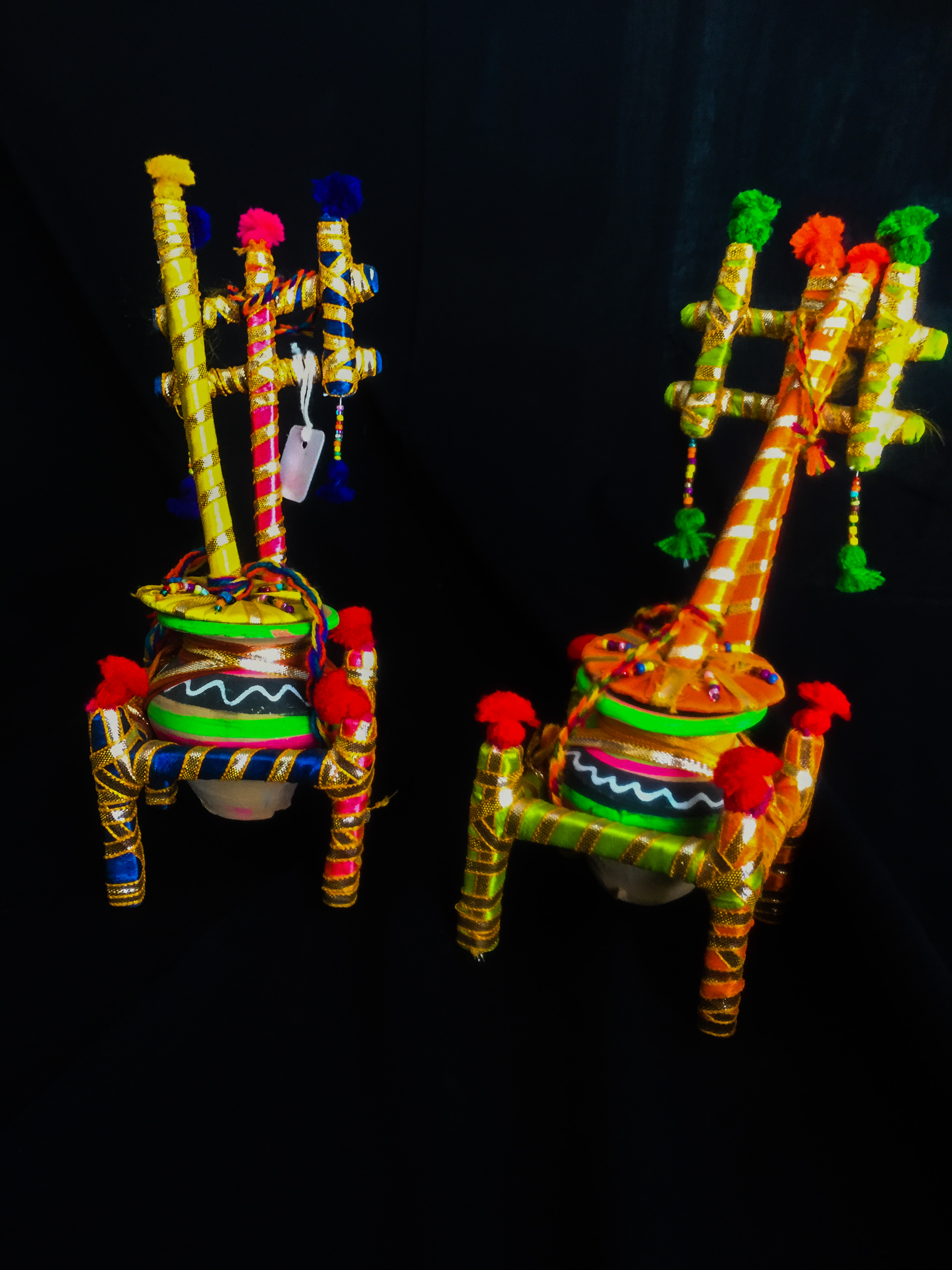
Hunar-e-Zan: Women’s Economic Empowerment
The very first initiative that the organization had taken with respect to women’s economic empowerment had been its work with home-based women workers in a squatter settlement in Karachi, Sindh. The tentacles of Globalization had certainly reached working class women, and especially the most exploited and oppressed sector of home-based women workers. After two years of organizing, in 2000 we were able to form a Home-Based Women Workers Collective in Qasba Colony and then spread the work in villages in two districts of Sindh, namely Tando Mohammad Khan and Badin. It should be noted that rural women are not only engaged in home-based work but also work on fields carrying out many forms of labor including cotton-picking, cutting sugar cane and fodder, among others. Home-based work provides them additional income as their work is mostly seasonal, and there are many days and months when they cannot find any work.
Our goal has been to ensure that women understand the roots of exploitation and oppression embedded in their lives through the joint pressures of feudalism, globalization, and patriarchy.
In May 2000, Roots for Equity supported women producers in launching their products at a stall in the Sunday Bazaar at Defence Housing Authority (DHA), Karachi. At the time, such local bazaars were a common feature of urban commercial life and provided critical access to middle- and higher-income consumers. Building on this experience, Roots for Equity operated a dedicated retail outlet, Hunar-e-Zan, from 2004 to 2014, first at Gulf Market, Clifton, and later at Khadda Market, Zamzama. Since 2007, the women’s collective has remained entirely self-financed through its own sales.
The Collective was able to market approximately one hundred products made by nearly 250 Women Home-Based Workers (WHBWs) but today it faces serious marketing constraints. The closure of Sunday bazaars in higher-income areas, which once constituted a major market for these products, along with the high costs of maintaining physical retail spaces, has significantly reduced access to consumers.
In 2010, Roots for Equity, with support from UN Women, conducted a nationwide research study to estimate the number of home-based women workers in Pakistan and document the types of goods they produce, along with their social and economic conditions. The study, titled “The Unacknowledged Treasures: The Home-Based Women Labor of Pakistan,” found that there are approximately 12 million home-based women workers in the country. The research identified patriarchy as the primary factor forcing women into poorly paid home-based work—where their labor is deemed acceptable only so long as it remains invisible, as public recognition of women’s work is often perceived as a threat to male honor.
While Sunday bazaars allowed some vendors to purchase directly from the collective, these intermediaries typically demanded a limited range of products; this constraint forces women to restrict their production and make only few items that were more in demand in the market. Over time, the disappearance of such markets and the decline of affordable physical retail options have further undermined sustainability.
In current times, there is a push to create online markets rather than only limit oneself to physical outlets. It is thought that modern digital platforms give women producers a steadier market. We have seen that the online sales platform links women producers to consumers across Pakistan and beyond. The online sales platform cuts the need for middlemen who keep prices low. The online sales platform makes the women’s labor visible, challenging rooted social norms that have long kept their economic contributions invisible.
Roots for Equity is therefore taking its first step in transitioning to online sales to sustain and expand markets for women’s beautifully crafted hand-made products. At present, 65 women are actively engaged in production, collectively creating many different products. These include embroidered bags, pencil and mobile covers, key chains, coasters and other products. Women also make ornaments like camel carts, dollis, charpais and manjhis. An online marketing strategy will enable the revitalization of this initiative, support stable incomes, extend market reach, and reinforce the collective’s long-standing model of self-financing advancing sustainable livelihoods and economic dignity for women home-based workers.
Visit our Instagram page for more pictures and to buy items.