Aliza Khalid | December 21, 2025
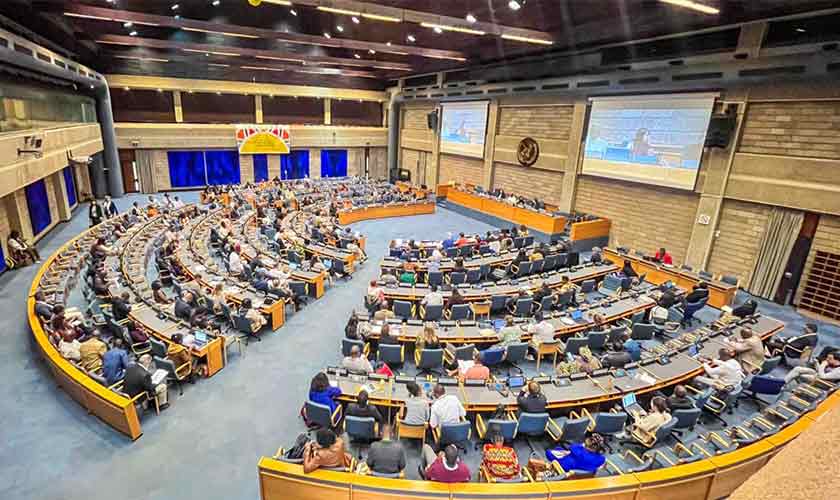
Geopolitical tensions have been directly pushing the seventh session of the United Nations Climate Assembly towards timid, lowest-common-denominator outcomes, as great-power rival states stripped draft resolutions of binding language and turned them into soft ‘cooperation’ statements,” said Wali Haider, leading the Farmers’ Major Group, at UNEA-7. The FMG participated in meetings, submitted statements and advocated for peasant and smallholder farmers’ rights, soil health, seed and food sovereignty. At a critical time, such as 2025, when we are off track to meet major requirements of climate treaties such as the Paris Agreement, climate governance should ideally strengthen to prevent further damage to the planet. For countries like Pakistan, the Conference of the Parties to the UNFCCC and the United Nations Environment Assembly are major events that determine future policies. The UNEA is the world’s highest-level decision-making body on the environment, providing overarching policy guidance. But UNEA-7 becomes a stage where the environmental crisis is acknowledged but never truly confronted, because confronting it would require confronting the industries and governments that currently run the world.
This year, it started with ambitious draft resolutions on the impact of AI, management of minerals and environmental crimes. Only 11 resolutions were passed. Half of the proposed texts remained an issue of debate and did not pass. These included those on critical issues such as environmental crimes and deep-sea protection. Ongoing wars and geopolitical tensions block any strong text on environmental harm in conflicts, with states insisting on vague wording to avoid legal exposure and resist references to conflict-linked destruction. Language became the centre stage of negotiations, with countries trying to dilute the wording of resolutions. When they are not clearly drafted, the resolutions become impractical.
“Ambition has been sacrificed on the altar of economic interests. The resolution on minerals and metals repeatedly collapsed because the world’s most powerful states refused to let global environmental rules interfere with their extractive and industrial interests. Mining corporations and metal traders sit invisibly behind national positions, pushing governments to strip out any binding safeguards or oversight of critical mineral supply chains. Diplomatic language about development, sovereignty, and enlightened self-interest becomes a shield to protect the destructive industries that fuel national wealth and geopolitical leverage.” Wali added.
Until the global political economy is restructured to integrate direct financing for vulnerable nations like Pakistan and provide groups like the Farmers’ Major Group with actual decision-making power, international assemblies will continue to be stages where crises are acknowledged but not resolved.
The real roadblock is not technical complexity. It is a global political economy engineered to defend extraction, even as the environmental crisis deepens. It is no longer a matter of confusion, lack of science or capacity gaps; it is a global political economy built on unchecked extraction and militarised resource competition that shifts the burden onto poorer communities and weaker states. Asked about the negotiations, Norway’s Minister of Climate and Environment Andreas Bjelland Eriksen said it had been a difficult year. “The mandate of the UNEP has been challenged at times. Negotiations have been tough as we had a hard time finding common ground or a common language to negotiate effectively,” he said.
A report by Climate Home News said states like Turkey, which is planning to host the COP31, have also been lobbying with other states to block some resolutions. Major powers like the US disassociated from the resolutions and raised questions on the principles and standards of global governance. Specifically, the US said they back out from the UNEP resolutions that they believed fell outside the organisation’s mandate. “Many resolutions contain problematic language recognising rights that do not exist. We are committed to pragmatic, science-based cooperation that advances environmental protection while respecting national sovereignty,” the US official addressing the closing plenary of the Assembly said.
Dalia Fernanda Marquez of the Women’s Major Group at the UN observed that some countries wanted to remove all references to gender from official texts. She argued that the assembly needs specific gender-based data, as a gendered perspective on the climate crisis is missing from these debates, especially in resolutions such as those on antimicrobial resistance, which must incorporate a gender perspective because women often serve as primary caregivers and agricultural workers. AMR refers to the process where bacteria and viruses evolve and no longer respond to medicines, creating a massive health risk. “At this UNEA, however, there has been more regression than ever,” she said.
This breakdown reveals that the voluntary model of international cooperation is incapable of managing a planet in crisis as it consistently prioritises national sovereignty and extractive economic interests over collective ecological stability. One of the primary structural flaws is the “consensus trap,” where the requirement for near-unanimous agreement allows veto to a single powerful nation or a small bloc of fossil-fuel-dependent states. To effectively address the climate crisis, the world needs a shift from “soft law” to “hard law,” characterised by legally binding enforcement mechanisms and independent monitoring bodies capable of prosecuting environmental crimes. Moreover, there is a pressing need to redefine international law to prioritise the global commons, such as the atmosphere and oceans, over the traditional concept of absolute national sovereignty, which currently allows states to destroy shared resources for short-term profit.
Until the global political economy is restructured to integrate direct financing for vulnerable nations like Pakistan and provide groups like the Farmers’ Major Group with actual decision-making power, international assemblies will continue to be stages where crises are acknowledged but never truly resolved.
The writer is a freelance climate journalist based in Lahore
Source: https://www.thenews.pk/tns/detail/1387934-the-changing-landscape-of-climate-governance